Persimyn: Preserving Context for AI-Assisted Work
Long-running work with AI produces choices, reasoning, and open questions that can be difficult to recover later. I developed Persimyn to preserve that context in project files, giving future conversations a record to build on.
Context and my contribution
Persimyn began inside my work on Plan Fit. By late 2025, I had databases, Python code, and working prototypes, but much of the product context remained in my head and scattered AI conversations. I needed to explain months of work to product managers, engineers, and leadership who hadn't participated in those conversations.
I developed the framework through my own projects, designed and built the desktop application with AI assistance, and created the starter kit and guide.
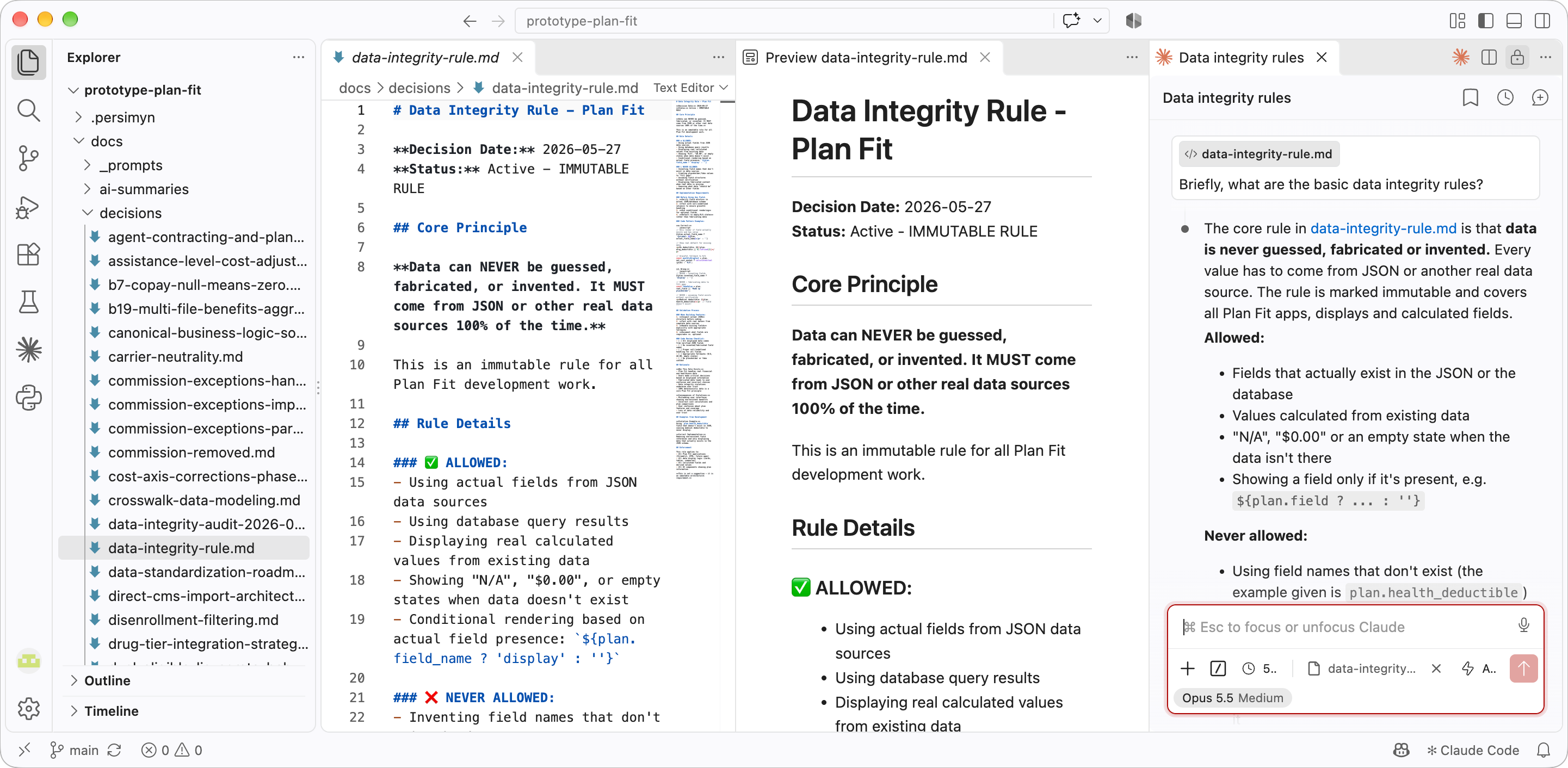
The early framework lived alongside Plan Fit’s code and documentation in Visual Studio Code, before I extracted it as DomainLab.
Preserving the context behind a choice
Persimyn gives a file-capable AI assistant instructions for keeping useful project context as part of the conversation. Explorations hold working ideas, decision documents retain choices and their reasoning, foundation notes hold reference knowledge, and source material stays available separately.
The distinction matters when work changes direction. A finished feature shows the approach that survived. A decision record can also explain an option that was set aside and what would make it worth reconsidering.
The assistant helps organize that material. The person confirms the choices. The record stays in ordinary Markdown files alongside the project, where another conversation can use it.
Developing the framework through project work
When I moved Plan Fit into Claude Code in January 2026, I began investigating what information an assistant needed to understand and continue the work. The initial structure separated product choices from reference knowledge and ongoing exploration.
I refined those conventions as Plan Fit developed. By spring, I was describing the approach as a reusable domain laboratory. I extracted it as DomainLab and applied it to AudiOasis and design-system projects.
Using it across projects exposed a maintenance problem: changes to the rules in one copy had to be carried into the others. The framework needed its own home. That work became Persimyn and led me to explore how other people might use the method.
AI drafts. You decide.
Designing a desktop application
The application brought conversation, editable records, project navigation, and summaries into a dedicated workspace. The intent was to make the method accessible for product thinking, including how teams would share context and how people would retain responsibility for decisions.
I worked through both the interface and the rules behind it: how readers would move from a project summary into its supporting documents, how an assistant would propose changes, and how an earlier decision would remain understandable after it changed.
Building the application exposed an integration gap. Some capabilities worked through my development tools but still required a separate implementation path inside the app. Setup and the shared experience also needed substantial work before someone else could use the product as intended.
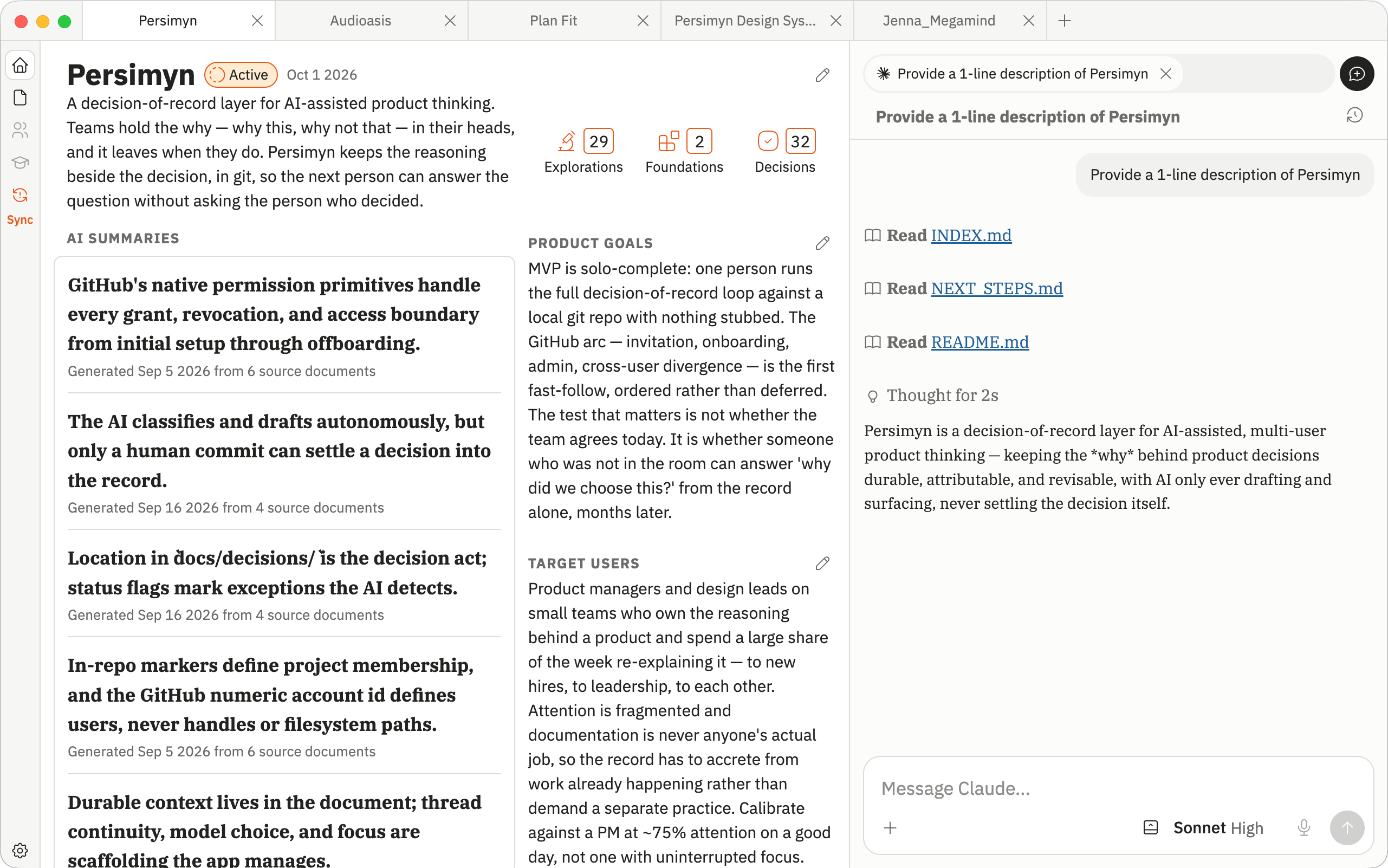 Overview screen
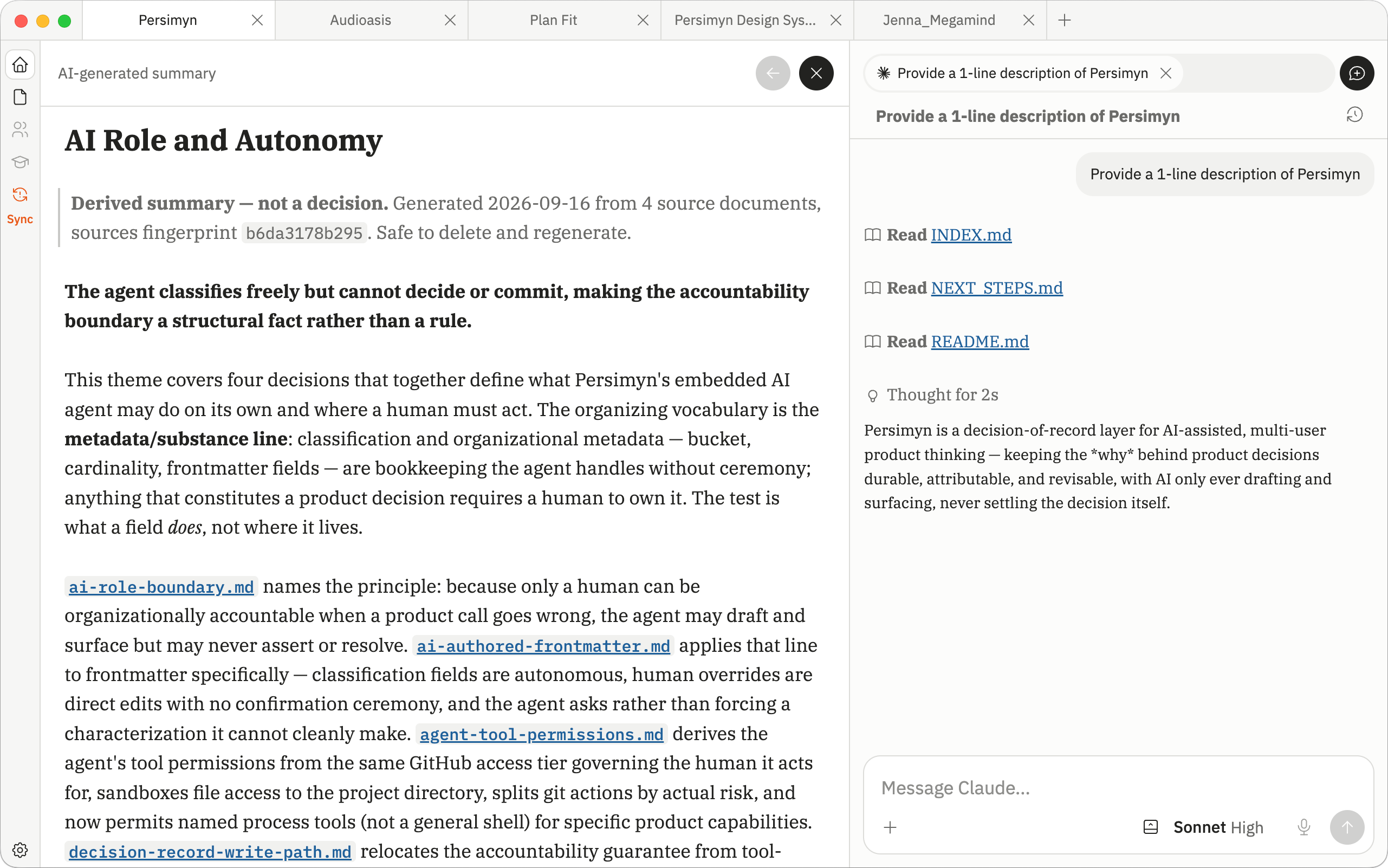
AI Summary screen
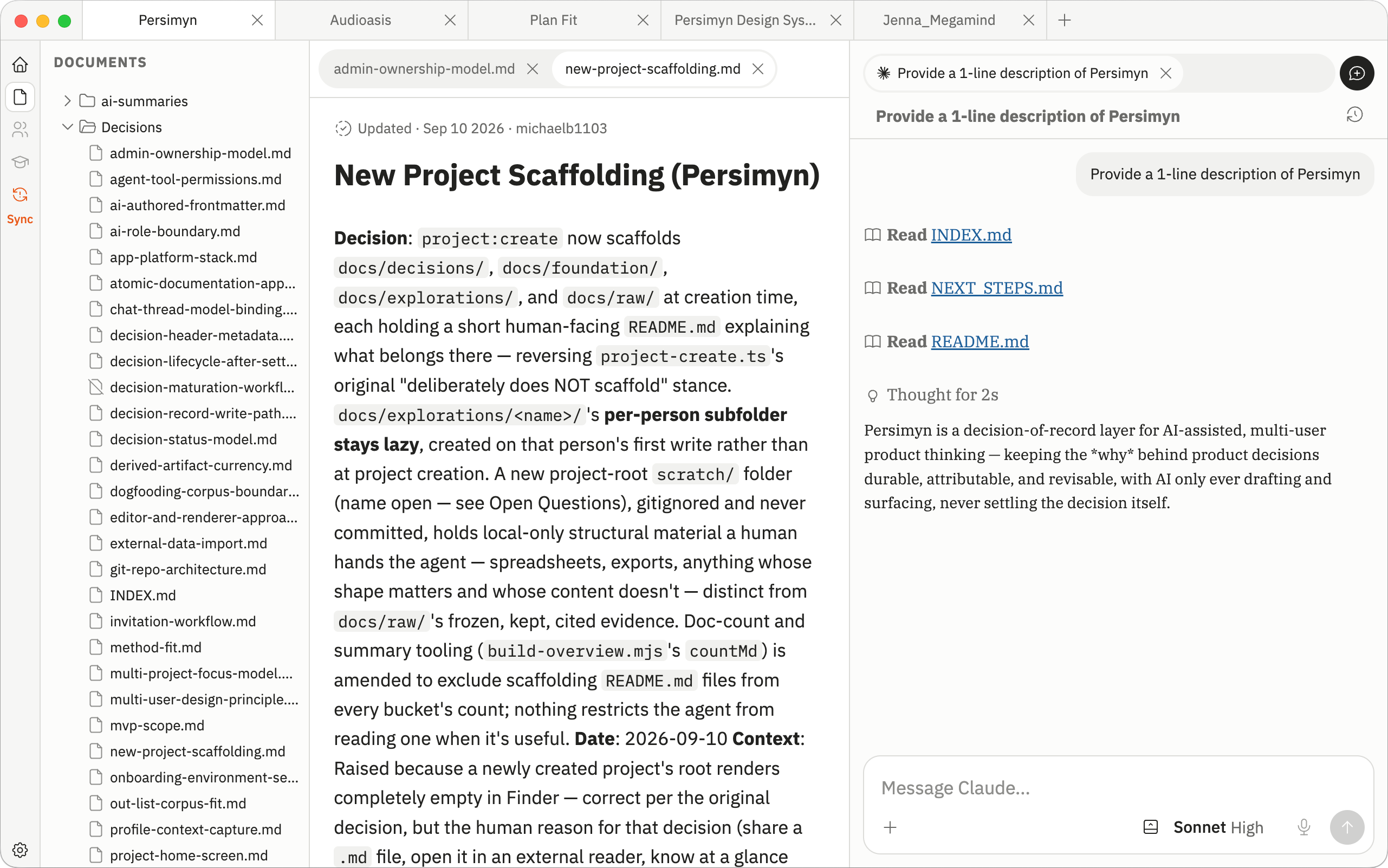 Document Tree screen
Reconsidering the delivery approach
In September, I reopened the case for continuing the application. Competition around product decisions and AI context was increasing, and I had to weigh the remaining development and commercialization work against what I could finish and maintain.
A dedicated app still had potential, but completing and maintaining it required more than I could take on. I chose to end that path and make the framework available through project folders, assistant instructions, and a guide. The method had been useful before the application existed; sharing it did not require finishing the larger product.
Testing and refining the framework
Returning to the framework put more emphasis on the assistant's behavior inside an existing conversation. I tested when it should offer to save something, how it should preserve an unresolved question, and what confirmation it needed before recording a choice.
During AudiOasis work, I found that the recording process asked for confirmation twice. Once the assistant had summarized a choice and I had agreed to record it, another confirmation added friction. I revised the instructions so that agreement was enough.
Continuing work across assistants
I used Claude and ChatGPT against the same AudiOasis project files. Each could continue from the shared record. This gave me a practical example of context moving between tools, although it remained my own workflow rather than a test of broader team adoption.
Keeping detail available for later use
The field work also clarified how I used the documents: as source material for later answers and explanations. The record needed to preserve enough detail for an assistant to recover the reasoning or prepare a focused summary. Every working note did not need to read like a finished presentation.
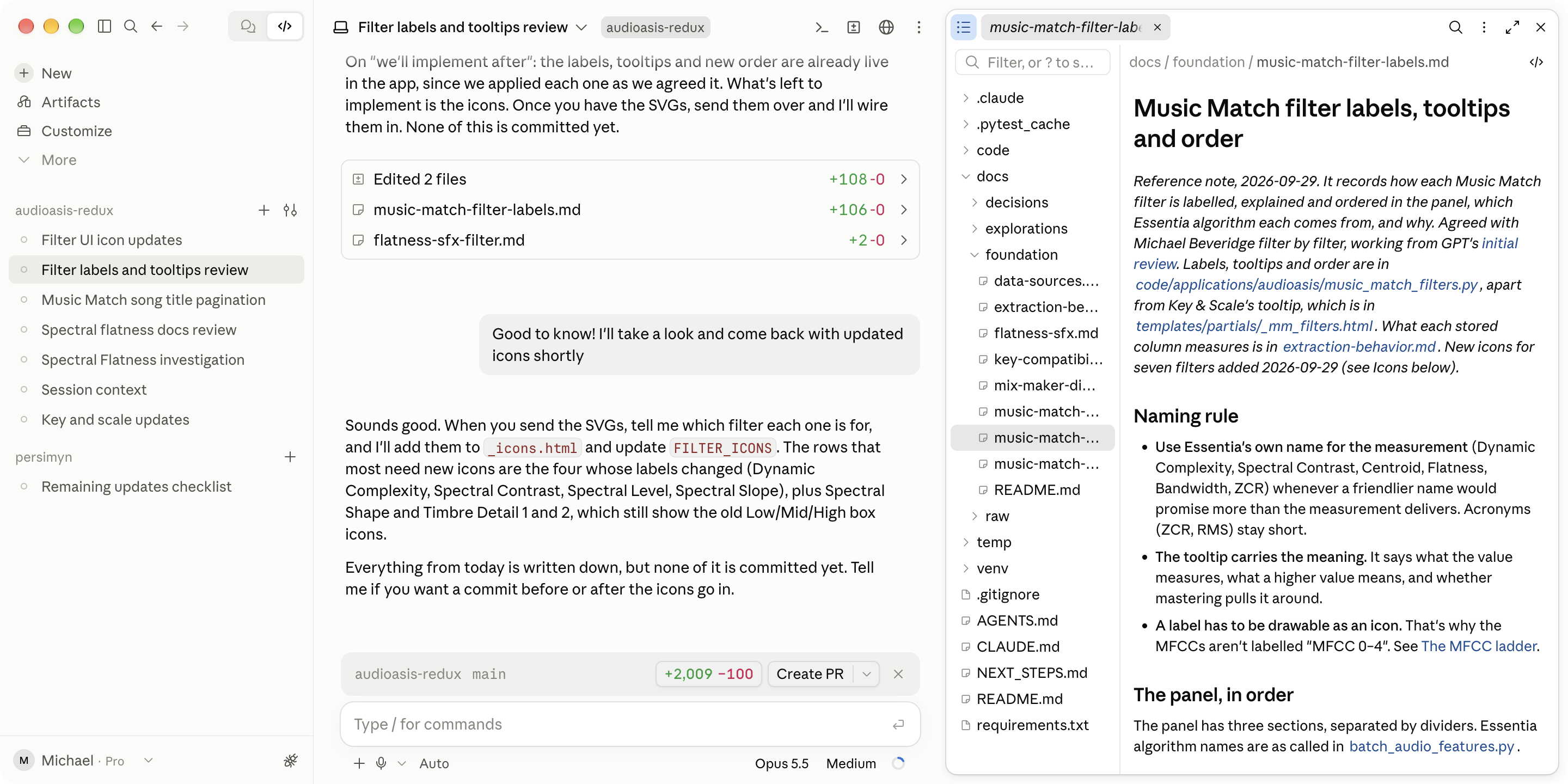 Using the framework in Claude </> (Code)
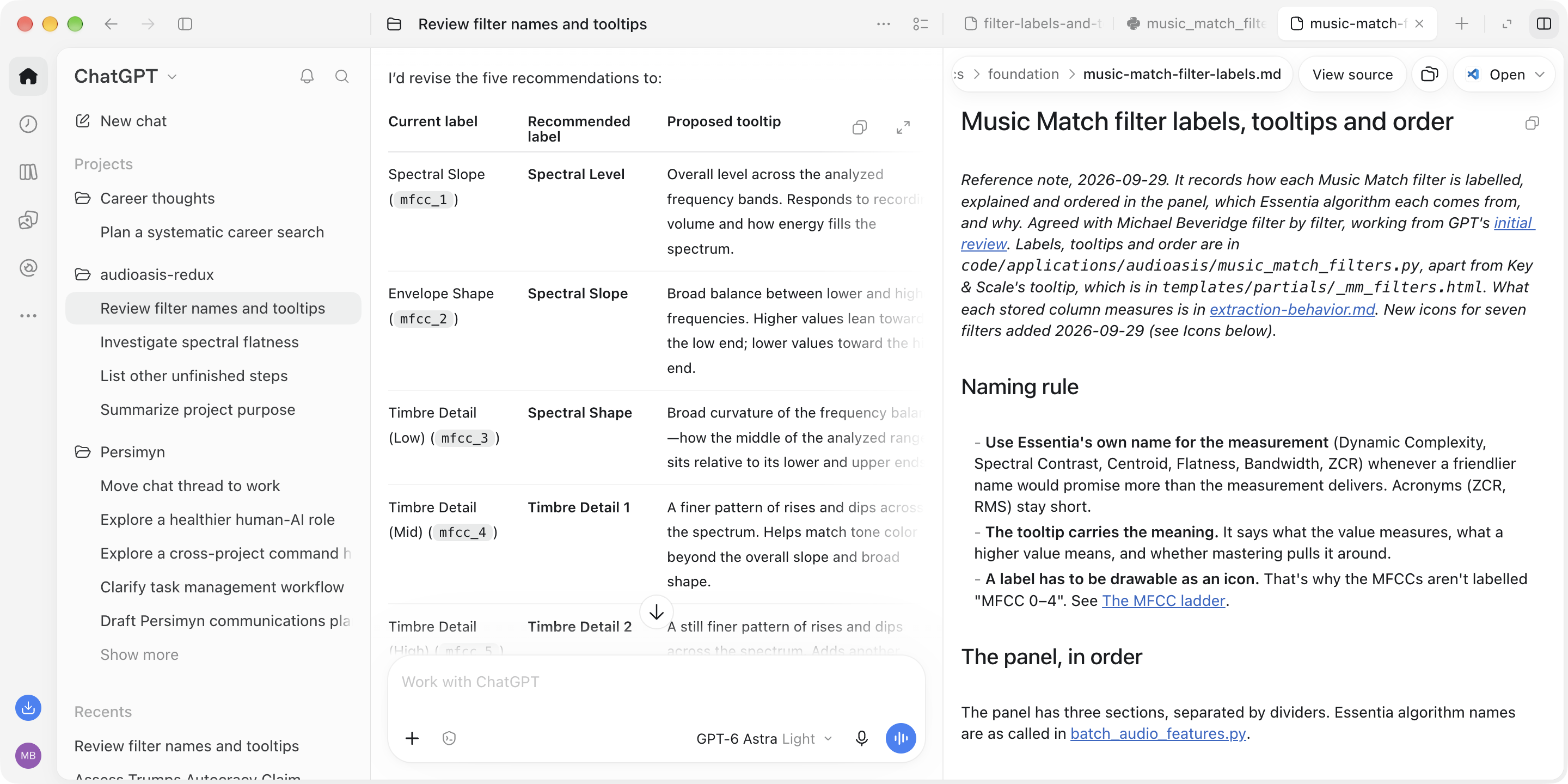 Continuing the work in ChatGPT Work
Project status as of October 2026
Persimyn is a free framework and starter kit with a public guide. Its delivery is close to the original DomainLab approach, incorporating conventions refined through the app work, scenario testing, and continued use on real projects.
The framework has been exercised through my own work and early testing. Broader adoption and shared-team use remain areas to validate. The application work is part of the project's history; the current deliverable is the kit and method.
The project extended my design work into the structure and behavior of an ongoing human–AI workflow: what gets preserved, how people confirm it, and how later work can use it.